

Why Hardcore Mode Lets You Be Wrong
Most games tell you immediately when you’ve made a mistake.
I wanted to know what happened if they didn’t.
That’s why Hardcore mode exists in Sudoku Fog.
Should a game protect players from mistakes?
Most games make this decision quietly. Quest markers point you where to go so you can’t get lost. Hints appear before you ask for one. Auto-save exists because losing progress to a bad decision feels unfair, not challenging.
None of that is wrong. It’s a design stance: protect the player, keep the friction productive instead of punishing.
Hardcore mode is the other stance. Instead of “we’ll catch you before it matters,” it’s “you decide when you want to know.”
The hardest mode, accidentally the easiest
Hardcore mode was supposed to be the hardest mode in Sudoku Fog.
It accidentally became the easiest.
It took me embarrassingly long to realize what I’d built. I only noticed after playing a few puzzles myself.
The mode wasn’t hiding information.
It was revealing the answer.
The fog itself was leaking the answer.
Fill a cell correctly, and the fog lifted.
Fill it wrong, and nothing happened.
That silence was information too.
All I had to do was try a number, glance at whether the fog moved, and undo it if it hadn’t. Repeat per cell until the board filled itself in through elimination — and even the fills I never undid cost nothing, because hardcore tracked a wrong-answer count that never touched your hearts.
The mode built to be less forgiving was measurably easier to brute-force than the normal one.
Moving the moment of truth
The fix wasn’t to make mistakes cost more. It was to stop answering the question at all until the player asked.
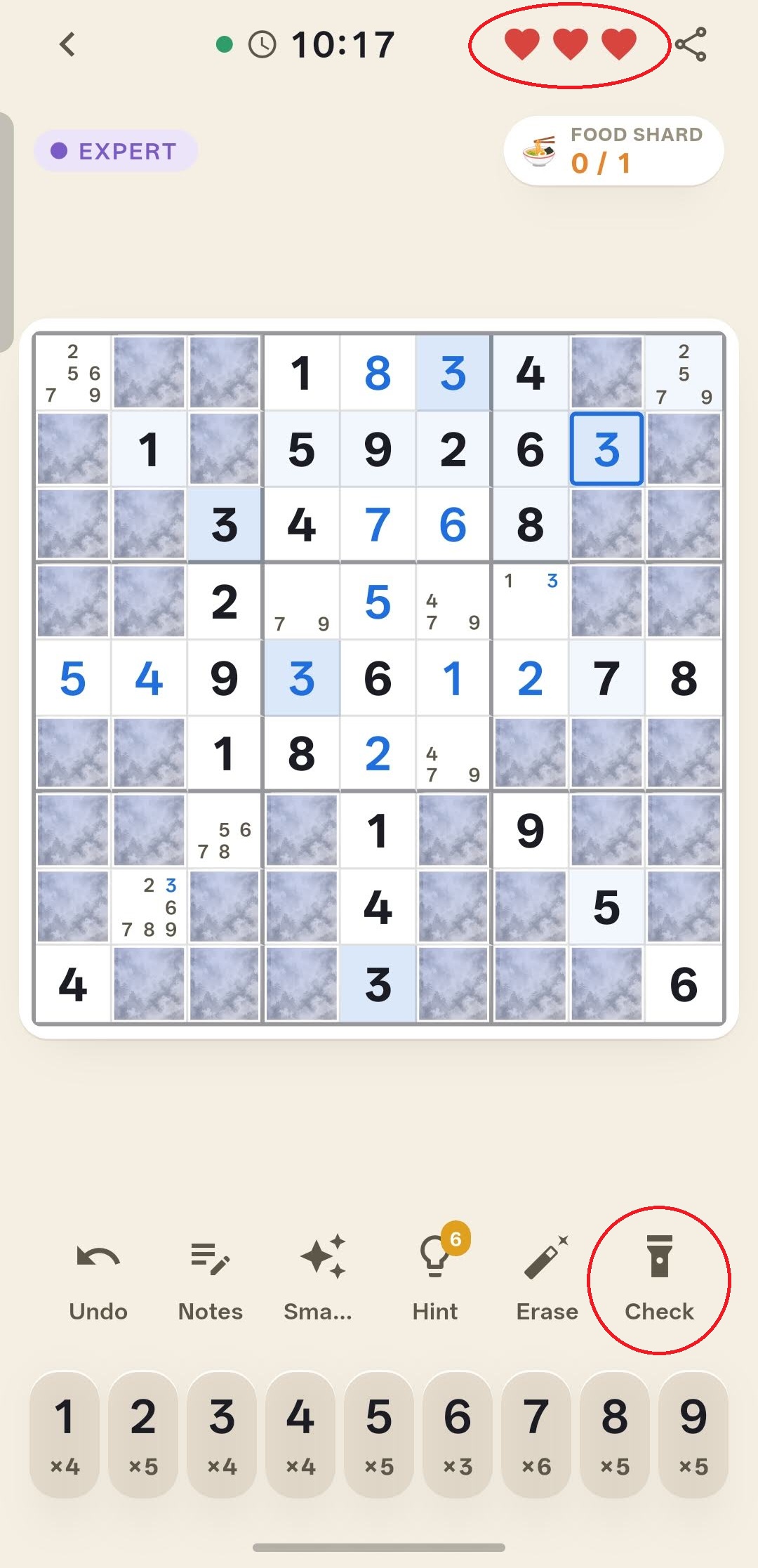
In the current version, filling a cell in hardcore mode gives you nothing back — no fog lift, no red flag, no color change, not even if you place a number that breaks a row or column outright. You can see what you typed. That’s all.
Certainty only arrives when you press Check. Every filled-but-unconfirmed cell gets verified at once: correct ones reveal and lock in, wrong ones clear back to empty and cost a heart — one heart per wrong cell, not one per check, so filling the whole board with guesses and checking once isn’t a shortcut anymore.
The Check button is always there. We just don’t press it for you.
What that changes
The puzzle underneath is identical to every other mode — same rules, same solution, same generator. What changes is who decides when doubt gets resolved. Normal mode resolves it immediately, on every keystroke, whether you wanted to know yet or not. Hardcore mode leaves you sitting with an unconfirmed board for as long as you’re willing to sit with it.
Not more mistakes. More time spent not knowing if you’ve made one. That’s the actual difficulty.
Hardcore mode isn’t about making Sudoku harder.
It’s about deciding when you want certainty.
The puzzle never changes. Only the player’s relationship with it does.
If you’re curious how this feels in practice, Hardcore mode is available in the current release of Sudoku Fog.
And if you’re interested in how features like this evolve over time, the DevLog covers the journey from prototype to release.