

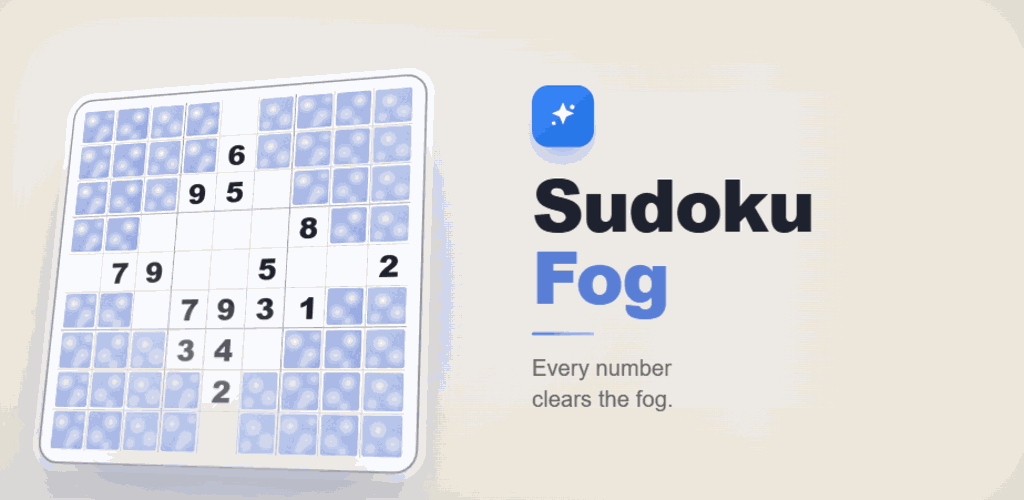
Sudoku Fog
LiveSudoku you uncover like a map — 10+ rule variants and their mixes, hidden under fog.
Free to download · Pro is a one-time purchase · No subscription
Sudoku you uncover like a map — 10+ rule variants and their mixes, hidden under fog.
Free to download · Pro is a one-time purchase · No subscription
Standard Sudoku hands you the whole puzzle at the start. Sudoku Fog does not. It wraps a standard Sudoku engine — every row, column, and 3×3 box still needs 1–9 without repeats — in a fog of war. Most cells start covered, and each correct placement lifts the fog around it, so the grid arrives a piece at a time.
That changes what solving feels like. You are not scanning a finished board for a pattern; you are working with the part you can currently see, and every placement can reveal more of it.
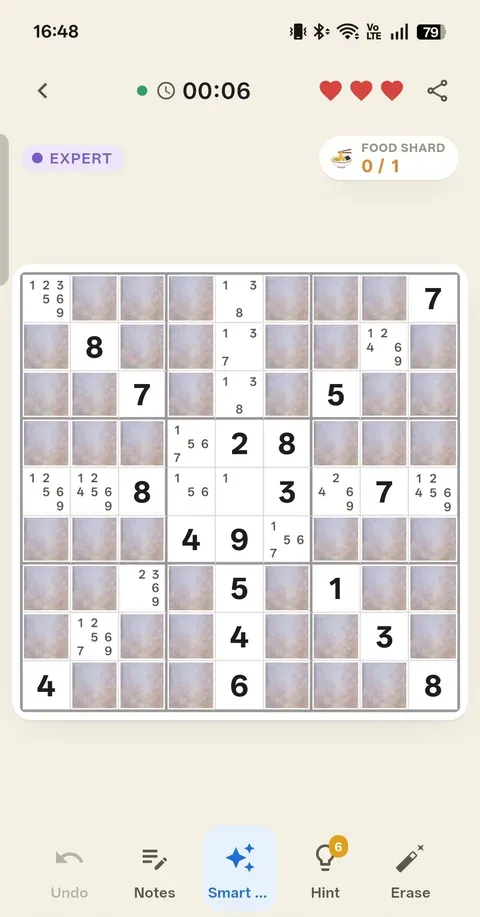
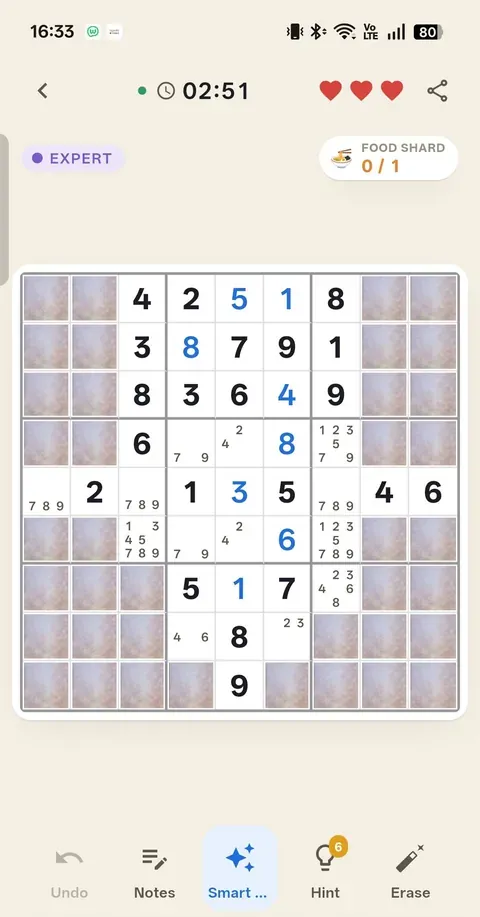
A variant adds one extra rule on top of classic Sudoku. Sudoku Fog’s variants run under the same fog as classic mode — so a constraint can be sitting in a cell you haven’t uncovered yet, and part of the work is reasoning about clues you cannot see.
| Variant | The rule |
|---|---|
| King’s Move | Cells a king’s move apart — diagonals included — can’t hold the same digit. |
| Odd/Even | A circle marks a cell that must hold an odd digit; a square marks one that must hold an even digit. Unmarked cells can hold either. |
| X-Sudoku | Both main diagonals must also contain 1–9 with no repeats. |
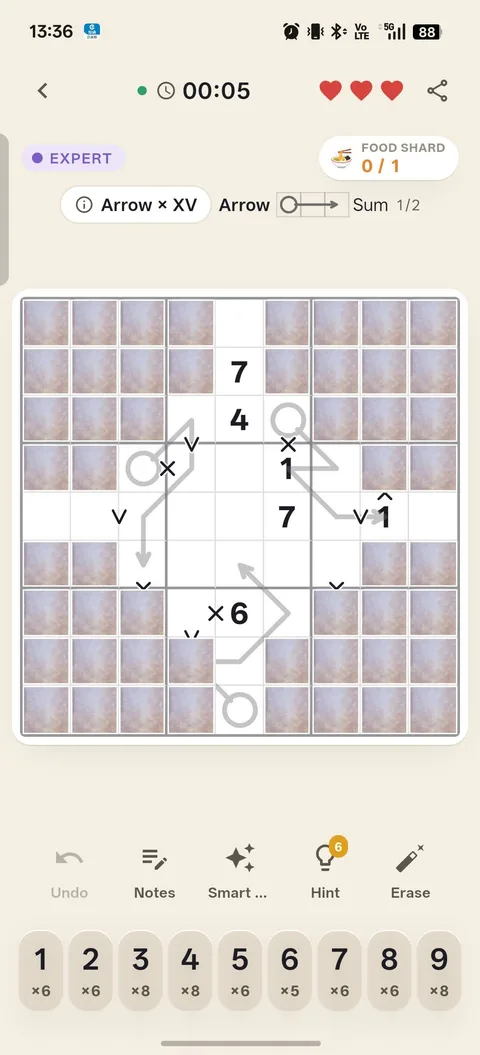
| XV | An X between two cells means they sum to 10; a V means they sum to 5. No letter between two cells means neither. |
| Consecutive | A bar between two cells means their digits differ by exactly 1. Two adjacent cells with no bar between them never differ by 1. |
| Kropki | A white dot means the two cells are consecutive; a black dot means one is double the other, and a 1–2 pair carries a black dot. No dot between two cells means neither. |
| Arrow | The digit in a circle equals the sum of the digits along its arrow. The circle itself is not part of that sum. |
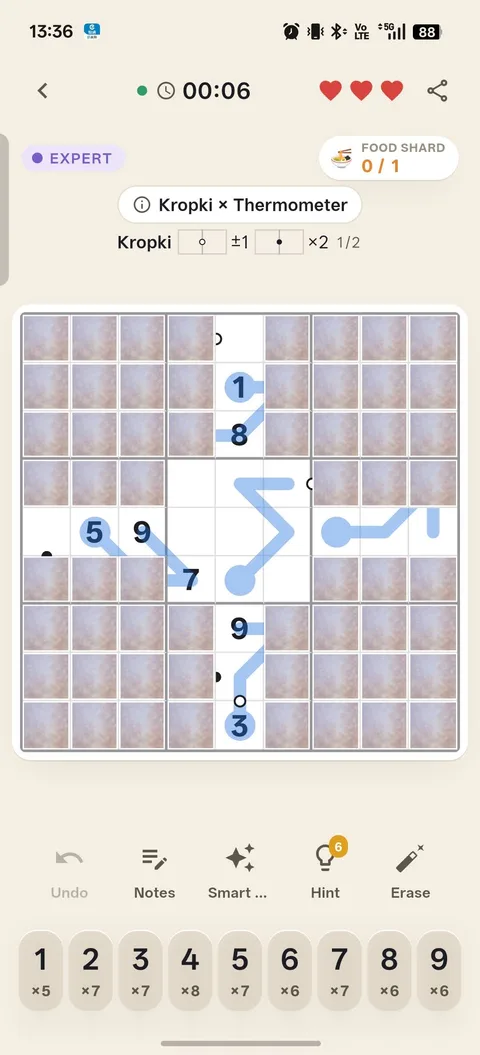
| Thermometer | Digits increase strictly along each thermometer, from the bulb to the tip. |
| Renban | Digits along a line form a run of consecutive numbers, in any order. |
| Anti-Knight | Cells a knight’s move apart can’t hold the same digit. |
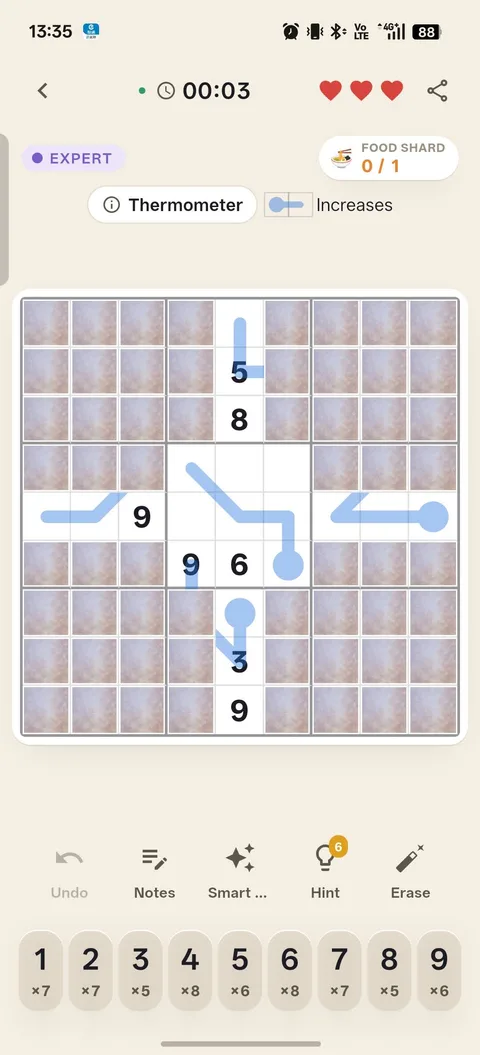
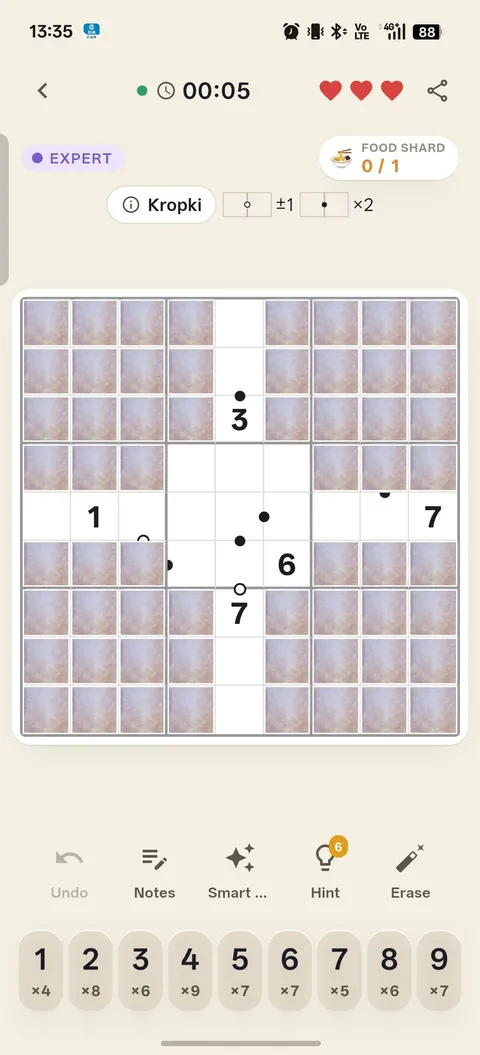
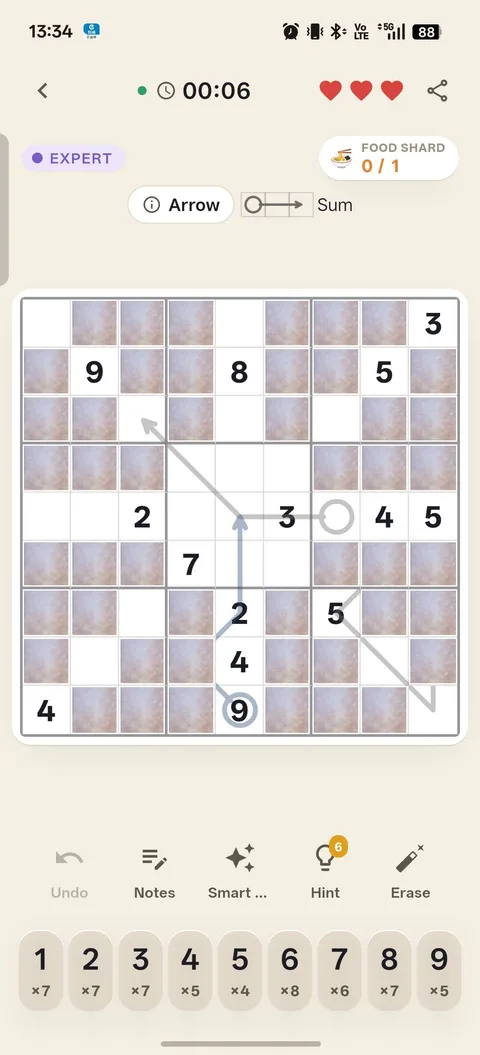
Some boards carry two rule sets at once. There are four hand-picked pairings — Thermometer × Arrow, Arrow × XV, Renban × Kropki and Thermometer × Kropki — and each opens up once you hold both halves. The two rules feed each other: the order a thermometer forces along its line is often the only thing that pins down what the arrow beside it can add up to.
A free player starts with King’s Move and Odd/Even, plus classic fog which uses no variant rule at all. The other eight open with variant unlock points, earned three ways: a win on Hard or Expert, and finishing the day’s daily challenge, are worth a point each and are capped at one a day apiece; streak milestones pay a bonus on top, and that bonus is not capped. Mixed variants need no unlock of their own — holding both halves is enough. Pro has every variant and every mix from the start, with no unlocking.
Hardcore mode. Mistakes aren’t flagged automatically — no safety net. You fill cells freely, then tap the flashlight to verify, and each wrong cell costs a life. It has its own leaderboard.
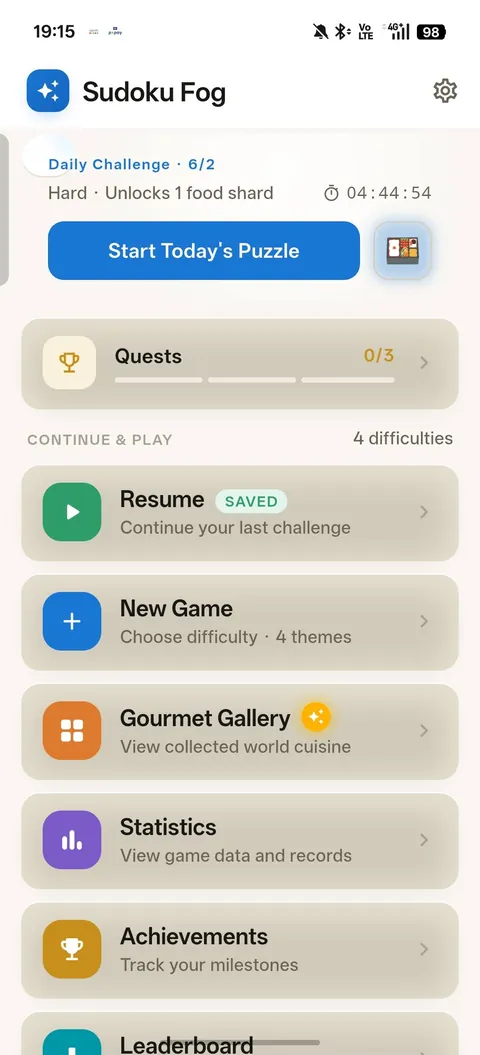
A daily challenge. One board a day, the same one for every player, and completing it earns a food shard. Weekdays are classic fog; on Saturday and Sunday the daily carries one of the variants. Finishing it without a single mistake pays a bonus.
Three quests a day. Small objectives — finish a Medium or harder game, reveal forty fog cells, take a Hard board with no hints — each paying a shard.
Four difficulties, separated by how many clues you start with.

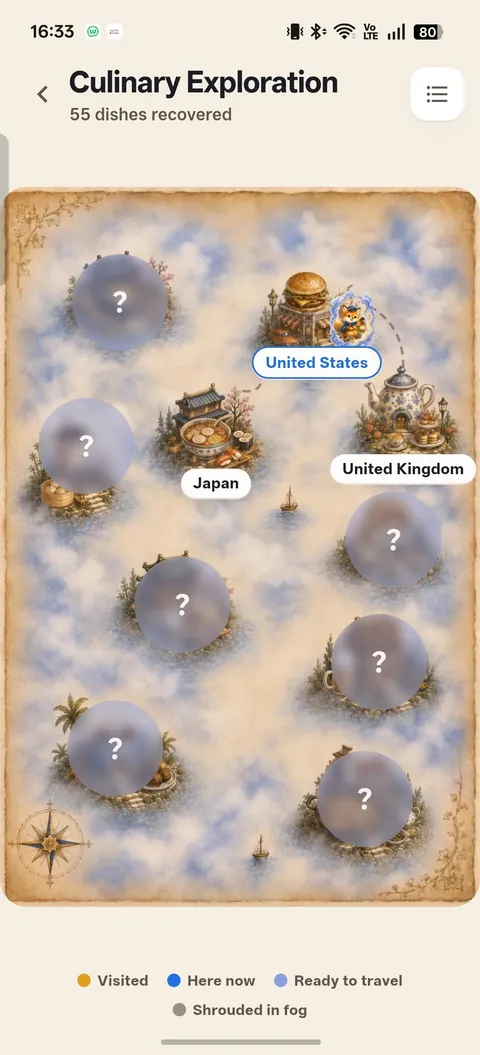
Hidden cells sometimes hold dishes from a global cuisine collection: ten countries, ten dishes each, from Taiwan and Japan through to France, Germany and Brazil. You don’t know what’s under the fog until it lifts, so every placement carries a second question alongside the logic. Shards buy the dishes; finishing all ten in a country lifts the fog to the countries beside it, so the map opens along a different route depending on where you started.
No account required to start
One-time purchase · No subscription
Pro buys convenience, not standing. No variant costs money — a free player can earn every one of them. What Pro changes is when you get them, not whether. The daily allowance refills each day, and finishing the daily challenge adds a smart note and a revive on top. And paying does not buy a place on the leaderboard: using a hint takes that game out of the rankings for everyone, Pro included.
Sudoku Fog is built for players who enjoy steady, satisfying logic rather than hunting for advanced whole-board techniques like X-Wing or Swordfish. Those techniques need most of the grid visible at once, and the fog is designed to take that away. If chasing large patterns across a full board is what you enjoy most, this is probably not the Sudoku for you.
What is Sudoku Fog? Classic Sudoku with the board hidden under fog. Every correct number you place clears the mist around it, so the grid is revealed as you solve.
Is it free? Free to download and play. Pro is an optional one-time purchase, not a subscription, and every variant can be earned without paying.
Do I need to install anything to try it? No. There is a demo board on this page that runs in any modern browser, with no account and no install. The full game is a free download for Android.
How is it different from normal Sudoku? The rules are identical. What changes is what you can see: you are deducing from a partial board and uncovering the rest as you go, instead of reading a finished grid.
Is there an iOS version? Not yet. Sudoku Fog is on Android only.
Sudoku Fog is on Google Play, for Android. There is also a playable demo board right here on this site — one puzzle, in the browser, no account and no install.
I built this because after years of solving Sudoku I missed the feeling of finding something I hadn’t already seen. Play one puzzle; five minutes is enough to know whether it works for you.